Summer Camp
When and Where
When:
July 5-11, 2026
, 8:30 am — 2:00 pm
Nights:
6
Location: Ten Mile River Scout Camps / Camp Aquehonga, campsite 7a
💲 Deposit Fee
Passed
When: 03/02/2026
🙋🏻♂️ RSVP
Passed
When: 05/04/2026
💰 Mandatory Fee
Passed
When: 07/03/2026
🩺 Medical Form
Passed
When: 07/03/2026
🚗 Go
Passed
When: 07/05/2026
Troop 23 Service Contribution
Menacing Monkeys Patrol
3 scoutsRyan & Chipmunks Patrol
2 scoutsAdditional Participants
3 total
Summer camp is the highlight of the Troop 23 year — a full week in the woods dedicated to adventure, friendship, and real growth. This summer we return to Camp Aquehonga at the Ten Mile River Scout Camps, a 12,000-acre Scout reservation in the Sullivan County Catskills near Narrowsburg, New York.
Aquehonga is Ten Mile River's patrol-cooking camp — our scouts cook many of their own meals in their own campsite, patrol by patrol. It sits on the shore of Half Moon Lake and is the only camp on the reservation with a swimming pool and waterslide. Between the pool, the lake, a high-ropes COPE course, shooting sports, a STEM center, and a full merit-badge program, there is more to do in a week than any scout can fit in.
The Week at a Glance
Camp runs Sunday to Saturday — six nights under canvas. Aquehonga is about a three-hour drive from Bay Ridge, so the troop gathers and travels up together from OLA and returns the same way.
- Meet at OLA: Sunday morning — drop-off around 8:00–9:00 am, then we load the cars and drive up together (exact time to be confirmed)
- Back at OLA: Saturday afternoon — pickup around 2:00 pm (to be confirmed)
- At camp: we reach Aquehonga around midday Sunday and check out Saturday morning after a cold breakfast
- Where: Camp Aquehonga, Ten Mile River Scout Camps — 125 Aquehonga Rd, Narrowsburg, NY 12764
- Getting there: about a 3-hour drive northwest of Brooklyn; the troop travels together and carpools with gear
- Meals: patrol cooking in our own campsite (some meals delivered hot as "heater stacks")
- First meal: Sunday supper (a camp BBQ) · Last meal: Saturday breakfast
Camp Aquehonga is in its 97th year of operation in 2026 — one of the longest-running Scout camps in the country, and a place Troop 23 has come back to summer after summer.
About Camp Aquehonga
Camp Aquehonga is Ten Mile River's home for troop patrol cooking — instead of a dining hall, each patrol picks up provisions from the commissary and cooks in camp, the way scouting is meant to be done. The campsites are spread through the woods around Half Moon Lake, each with a picnic table, latrine, cots, and a dining-fly shelter.
What sets Aquehonga apart among the three TMR camps:
- Pool & waterslide — Aquehonga is the only TMR camp with a swimming pool, and the waterslide is unique to this camp
- Half Moon Lake — canoeing, kayaking, rowing, stand-up paddleboarding, and small-boat sailing
- COPE & Climbing — low and high ropes courses, a climbing tower, and a zip line (one of the camp's biggest draws)
- Barta Field — archery, .22 rifle, shotgun, cowboy action shooting, and field games
- Johnson Center — the STEM center, camp office, and commissary
- Nature Center, Scoutcraft, Handicraft, Tradecraft & Performing Arts program areas
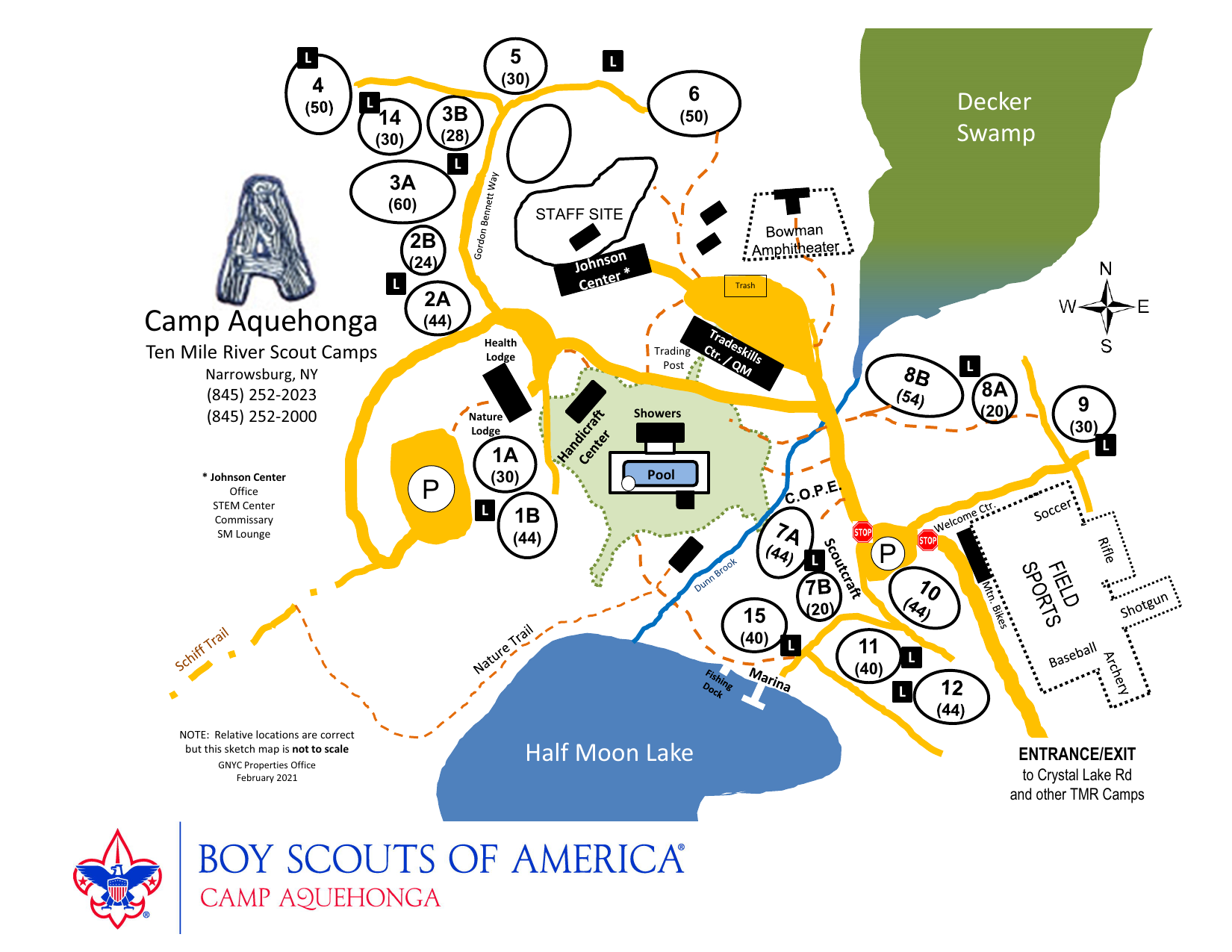
The camp map below shows the campsites (with capacities), the pool and lake, the program areas, and the entrance road. Learn more about all three TMR camps on our Ten Mile River Scout Camps page, or at the official Camp Aquehonga site.
Arrival Day
We gather at OLA on Sunday morning, load the cars, and make the roughly three-hour drive up to camp — stopping for lunch along the way (bring a bagged lunch or money to buy it). The road into Aquehonga is long — the camp sits deep in the woods. When we reach the entrance around midday, a staffed stand on the road in directs each car, and a Site Guide meets the troop and walks us through the first day, step by step:
- Meet the Site Guide & set up camp — find our campsite and get tents and gear squared away
- Financial check-in — a troop leader confirms the roster and payments at the camp office
- Medical recheck — the camp medical officer reviews every scout's and leader's health form and collects any medications
- Swim test — every scout and adult is classified as Swimmer, Beginner, or Non-Swimmer
- Flag ceremony & BBQ dinner — the camp gathers on the parade field, then eats together
- Pool orientation — waterfront safety briefing (miss it and you can't use the aquatics areas)
- Opening campfire — staff skits and songs at the Shawn E. Bowman Jr. Amphitheater; lights out at 10:00 pm
Pack your swim trunks and a towel on top of your pack. The swim test happens the first afternoon, and it decides what you can do all week — canoeing, kayaking, the pool, and every aquatics merit badge require a Swimmer classification. Scouts who don't pass on Sunday can retest during the week, and instructional swim is offered twice a day.
A Day at Camp
Camp days have a steady rhythm. Reveille and breakfast, a camp-wide flag raising, three morning merit-badge sessions, lunch and a midday break, three afternoon sessions, the flag lowering and patrol-cooked dinner, then an evening program before taps.
- Morning: flag raising, then merit-badge sessions at 9:00, 10:00, and 11:00
- Midday: lunch and a siesta — campsite and patrol projects, happy hour, free time
- Afternoon: merit-badge sessions at 2:00, 3:00, and 4:00, plus troop free swim and open boating
- Evening: flag lowering, dinner, and a camp-wide program; quiet time at 10:00 pm
The evening programs are half the fun of camp. Over the week they include Aqua-Olympics at the pool, an Order of the Arrow ice cream social, an Iron Chef cook-off, open shooting ranges, "Dunk the Counselor" fire-building, a Friday camp BBQ, and a closing campfire where honor units are recognized. Early risers can take the Polar Bear swim before breakfast (Tuesday and Thursday), and strong swimmers can qualify for the Mile Swim across Half Moon Lake.


Merit Badges & Advancement
Ten Mile River runs one of the largest camp merit-badge programs in the region — more than 60 badges across Aquatics, Scoutcraft, Nature, Field & Shooting Sports, Handicraft, Tradecraft, STEM, Performing Arts, and COPE. Scouts choose their classes ahead of camp and fill their day with them — the full program, prerequisites, and camp policies are laid out in the TMR Leader's Guide.
This year our scouts are working on a broad slate, including Orienteering, Swimming, Environmental Science, Forestry, Mammal Study, Reptile & Amphibian Study, Electricity, Digital Technology, Athletics, Personal Fitness, Camping, Cooking, Canoeing, and Kayaking — along with instructional swim and the camp's New Camper Program. Several of these are Eagle-required badges (Camping, Cooking, Environmental Science, Personal Fitness, and Swimming), so older scouts use camp to make real progress on the Eagle trail.
A few things worth knowing before camp:
- Prerequisites matter. Many badges — Camping, Cooking, Personal Fitness, Environmental Science, Emergency Preparedness — have requirements that can't be finished in a week and must be started at home. Bring the merit-badge pamphlet and any worksheets.
- Partials are normal. If a badge isn't finished by Saturday, the scout earns a "partial" and completes the rest back home. Partials stay valid until the scout turns 18.
- Swimmer classification gates aquatics. Swimming, Canoeing, Kayaking, Lifesaving, and the other water badges all require passing the Swimmer test.
- Some badges have age or grade minimums — Rifle Shooting (12+), Shotgun and Climbing (13+ or 7th grade), for example.
New to camp? Start with the New Camper Program
First-year campers are encouraged to join the Aquehonga New Camper Program. Scouts are placed in patrols led by a Life or Eagle Scout guide and work through the skills for Tenderfoot, Second Class, and First Class rank — knots, camping, cooking, hiking, and swimming basics — instead of jumping straight into harder merit badges. Graduates earn the Aquehonga Distinguished Camper award. It's the best possible start to a scouting career, and it makes the whole week less overwhelming for a new scout.
Beyond merit badges, a week of camp counts toward rank in a lot of quiet ways: camping nights toward the Camping merit badge and rank requirements, aquatics time, cooking a meal for your patrol, and living the patrol method day in and day out.
Food & Patrol Cooking
Aquehonga is a patrol-cooking camp, and that's a big part of its character. Each patrol picks up food from the commissary and cooks its own meals in its campsite, using camp-issued chef kits, cook kits, propane, and menus. Learning to plan, cook, and clean up as a patrol is exactly the kind of teamwork camp is built to teach — and it doubles as advancement toward cooking and camping requirements.
For any meal a patrol would rather not cook, the camp offers "heater stacks" — hot, pre-cooked meals delivered in insulated containers. Troops can cook every meal, take heater stacks all week, or mix and match. Sunday supper is a camp-wide BBQ, and Saturday's send-off is a cold breakfast picked up on the way out.
One meal happens before camp cooking begins: lunch on the drive up. The troop stops on the road to Aquehonga, so every scout should bring a bagged lunch or money to buy lunch on Sunday.
What to Pack
Pack for a full week outdoors — hot days, cool nights, and a lot of time in and around the water. Label everything with the scout's name, and remember to put swim trunks and a towel on top of the pack for the Sunday swim test.
The essentials (musts)
- ⧠ Completed, current BSA medical form — Parts A, B & C (see the health form section below)
- ⧠ Any prescription medications (handed to the Scoutmaster / camp nurse at check-in)
- ⧠ Full Class A field uniform (for travel, flags, and dinners)
- ⧠ Class B / activity shirts for daily wear
- ⧠ Sleeping bag (or 3 blankets) and a pillow
- ⧠ Sleeping pad or air mattress
- ⧠ Clothing for the week — T-shirts, shorts, long pants/jeans, athletic socks (1 pair/day), Scout socks, underwear, sleepwear
- ⧠ Warm sweater or jacket for cool nights
- ⧠ Poncho or rain jacket
- ⧠ Broken-in hiking boots + a second pair of sneakers + waterproof footwear
- ⧠ Swim trunks — no cut-off jeans, and no metal grommets at Aquehonga (the waterslide)
- ⧠ Towels (one for swimming, one for showers)
- ⧠ Toilet kit — soap/shampoo, toothbrush & toothpaste, comb, tissues
- ⧠ Refillable water bottle
- ⧠ Insect repellent — lotion, not spray (aerosols are not allowed)
- ⧠ Flashlight or headlamp + extra batteries
- ⧠ Scout Handbook
- ⧠ Pocketknife — no sheath / fixed-blade knives (Totin' Chip)
- ⧠ Sunscreen, sunglasses, and a hat
Recommended extras
- ⧠ Merit-badge pamphlets and worksheets for your classes
- ⧠ Compass, notebook, and pen/pencil
- ⧠ Individual first-aid kit
- ⧠ Backpack for day hikes, laundry bag, watch, camp chair
- ⧠ Fishing tackle (Half Moon Lake), props for patrol skits
- ⧠ Spending money for the Trading Post — about $100 for the week
Please leave at home
Expensive electronics, tablets and handheld games, valuables and jewelry, firearms/bows, fireworks, aerosol cans, sheath knives, and anything else that distracts from camp.
A fuller version is in the official TMR Suggested Packing List attached at the bottom of this page.
Health Form & Medical
Every scout and every adult staying at camp must arrive with a completed BSA / Scouting America Annual Health & Medical Record (AHMR), Parts A, B, and C. Part C is the physician's exam — it must be signed by a doctor within one year of the last day of camp, so a physical from the previous summer will not carry over past its anniversary. Plan the doctor's visit early; this is the single most common reason a scout can't check in.
- Immunizations must be listed with dates — including measles (a Sullivan County requirement for everyone at camp). If you have a separate immunization record, the dates still need to be filled in on the medical form itself.
- Bring a photocopy of the insurance card with the form — camp keeps the forms and does not return them.
- Medications are turned over to the camp medical officer at check-in and dispensed on schedule from the medical lodge.
- A parent or guardian must sign for any scout under 18.
The form to use is the Ten Mile River / GNYC medical packet — it bundles the BSA health record (Parts A, B & C) with the Sullivan County immunization requirements and a sunscreen and bug-spray permission form for a parent to sign. Adults: the same A/B/C requirement and immunization-date rule applies to you.
Camp Aquehonga
Camp Aquehonga is part of the Ten Mile River Scout Camps, roughly a 3-hour drive from Brooklyn in the Sullivan County Catskills. GPS set to "Ten Mile River Scout Camps" lands at the reservation headquarters — follow the camp road signs to Aquehonga from there. Camp office: (845) 252-2023; TMR 24-hour line: (845) 252-2000.
Camp Aquehonga — Ten Mile River Scout Camps, Campsite 7a
Address:125 Crystal Lake Road
Narrowsburg, NY, 12764
Coordinates(i): 41.601942°, -74.9434963°
Google Maps | Waze | Organic Maps
Opportunities Realized
A week at Aquehonga is one of the richest advancement opportunities of the year — a full slate of merit badges earned in class, plus rank requirements knocked out just by living the patrol method for six days. It supports, among others:
- Camping — up to six consecutive nights of long-term camp toward Camping merit badge Req. 9a, and the camping, tent-pitching, and Outdoor Code requirements for Tenderfoot through First Class
- Cooking — planning and cooking patrol meals: the Second Class / First Class cooking requirements and Cooking merit badge Req. 5 (five meals cooked outdoors)
- Orienteering & navigation — the Orienteering merit badge and the compass / map requirements for Second and First Class
- Scoutcraft & nature — lashings and a camp gadget (First Class), wildlife identification, and plant study
- Aquatics — swim classification and the Second / First Class swimming requirements, plus Swimming and boating merit badges
- Flag ceremonies — the daily camp-wide flag raising and lowering cover Tenderfoot 7a and the Second Class flag requirements
- First Class trail — the New Camper Program walks first-year scouts through the Tenderfoot → First Class skill set
Nights
Miles
Aquatics
Climbing
Service
Totals across everyone who took part.


 See all 392 photos
Documents
-
Ten Mile River Camp Medical Form 2025 (GNYC)
The TMR / GNYC medical packet: BSA Annual Health & Medical Record Parts A, B & C (form 680-001, rev. 3/19/25); New York State / Sullivan County immunization requirements (Public Health Order No. 1); and the sunscreen & bug-spray permission form.Greater New York Councils, BSA — Ten Mile River Scout Camps
-
Ten Mile River Summer Camp Packing List
Suggested packing checklist for a week at Ten Mile River summer camp (from the 2026 Leader's Guide).Ten Mile River Scout Camps
-
Camp Aquehonga Map — Ten Mile River Scout Camps
Printable Camp Aquehonga map — Ten Mile River Scout Camps, Narrowsburg NY: numbered campsites, Half Moon Lake, swimming pool, Scoutcraft, COPE, Field Sports, Johnson Center.Ten Mile River Scout Camps — GNYC Properties Office, Feb 2021
-
Ten Mile River Summer Camp Leader's Guide 2026
The complete 2026 Ten Mile River Scout Camps leader & parent guide — dates, fees, program, policies, and camp maps.Ten Mile River Scout Camps
Last updated on October 14, 2026